


The Multi-Stage Sell: How Promotional Pricing Reshapes Consumer Broadband Globally
by Soichi Nakajima
Buying a fixed broadband plan today rarely means buying it at a single price. Across Tarifica’s Telecom Pricing Intelligence Platform (TPIP), covering 6,945 standard consumer broadband-containing plans across 46 markets in Q1 2026, 57% of those plans carry a promotional discount that runs for a defined period before the full price applies. The consumer sees the promotional price, signs up to it, and pays it for as long as it lasts.
What changes the picture is what surrounds that promotional price: the standard price that the discount is set against and the customer eventually rolls into, and — for a growing share of plans — a secondary escalator step in between. For more than half of the world’s consumer broadband plans, the standard monthly price is not a single transaction value. Rather, it is the long-run resting place at the end of a multi-stage price ladder.
The Promo: No Longer the Exception
Across the four quarters from Q2 2025 to Q1 2026, the share of consumer broadband plans tracked by TPIP that include a promotional price has held steady between 56% and 63%. In Q1 2026, the figure stood at 57%. The median discount among those plans was 29%, down from 33% twelve months earlier — a modest compression as operators moderate the depth of their introductory offers.
The flat aggregate conceals an enormous geographic spread. In Argentina, 98% of consumer broadband plans tracked carry a promotional price. The Netherlands sits at 95%, Ireland at 94%, Australia at 94%, Chile and Canada both at 91%, Switzerland at 88%. In these markets, the promotional structure is no longer an occasional acquisition tool; it is how consumer broadband is sold. At the opposite end, several markets have effectively no promotional layer at all: Oman, Kuwait, Belize, Guatemala, Honduras, Nicaragua, and El Salvador are all at zero. Saudi Arabia sits at 7%, Italy at 5%, the United Kingdom at 9%. In those markets, the standard price is the price the consumer signs up at.
What the Standard Price Actually Represents
In the markets that promote heavily, the standard monthly price is rarely the price a new customer pays. But it is not fictitious either. It is the price the same customer will pay once the promotional period ends, typically six, twelve, or twenty-four months later. It is also the reference point against which the savings of the promotional period are advertised.
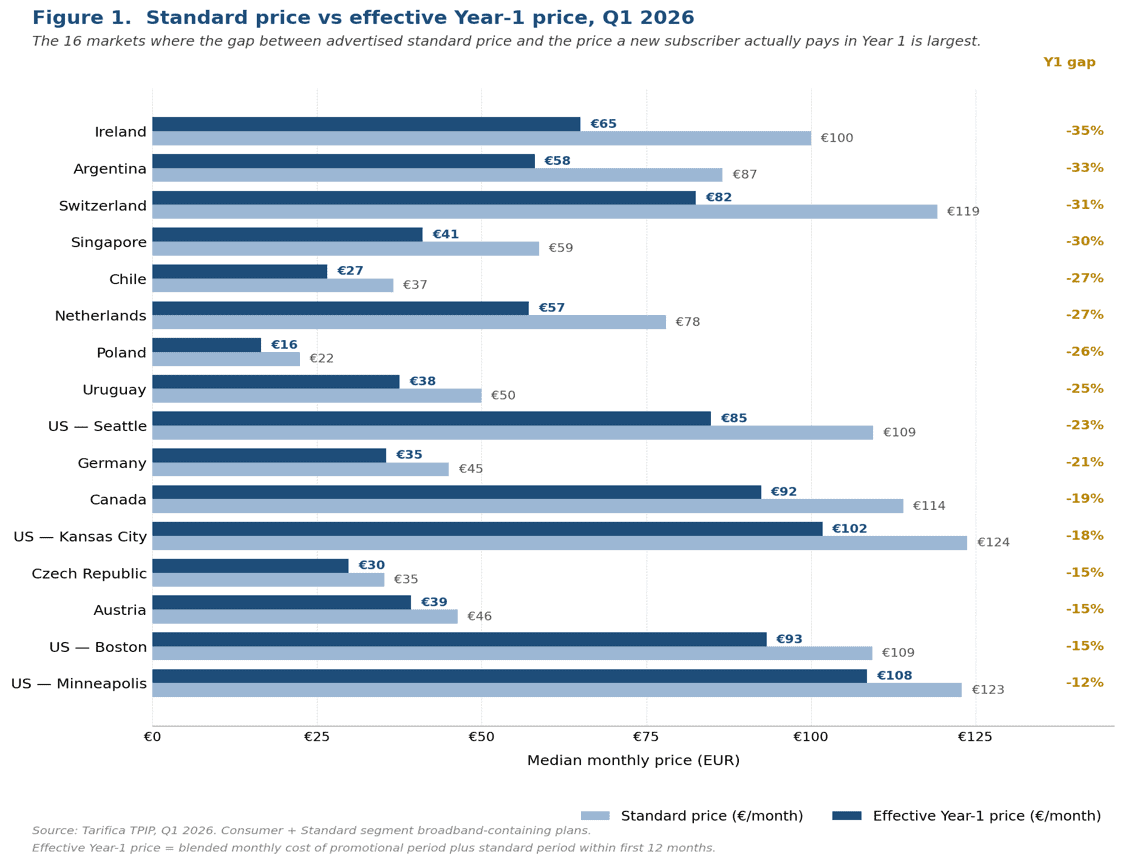
The implication is visible in the data. Computing each plan’s effective first-year monthly price — promotional rate for the promo months, standard rate thereafter — produces a number meaningfully below the standard price in many markets. Ireland’s median consumer broadband plan has a standard price of €100 but an effective Year-1 price of €65, a 35% gap. Argentina shows a 33% gap (€87 to €58), Switzerland 31% (€119 to €82), Singapore 30%, the Netherlands 27%, Chile 27%. On promotional plans, the median first-year savings reach €712 in Minneapolis, €521 in Switzerland, €492 in Ireland, and €478 in Canada. For the consumer, these are real first-year savings. For the operator, those savings are not a sweetener; they are the offer.
Two Strategies: Deep But Brief, Modest but Sustained
Within the set of plans that do promote, operators have settled on two distinct approaches. The first is a steep discount of short duration. Japan’s promotional plans show a median 86% discount, but for only six months. Germany sits in similar territory at 56% over 10 months. Argentina takes the brevity to its extreme: often a free first month, then straight to the standard price. Whether the customer gets a few months of near-free service or a single free month, the standard price arrives quickly. The discount drives acquisition; the standard price drives revenue.
The second is the opposite: a smaller discount stretched over a much longer commitment. Switzerland’s median promotional period runs for 24 months at a 32% discount; Canada and Singapore are also at 24 months and 20–40%. In these markets the “promotional price” is, in practice, the contract price — a label retained mostly for the marketing optics of being able to advertise a higher number alongside it. The snap-back, when it eventually arrives, happens at the same point a customer might naturally re-evaluate the plan anyway.
The Escalator Inside the Escalator
About 14% of consumer broadband plans now use a two-tier escalator structure: a deep initial discount, a moderately discounted secondary price for a second phase, and the standard price thereafter. Eir Ireland’s “Fibre Broadband 5Gb + TV + mobile + Talk International” plan illustrates the design: €99.96 for the first 12 months, €109.96 for the next 12 months, then €144.96 thereafter. The customer is not signing a contract at a single price; they are signing into a three-step ladder where the most expensive step is reached only in year three.

The Netherlands leads the world in this approach, with 56% of consumer broadband plans using two-tier pricing. Argentina sits at 51%, Mexico at 40%, Poland at 33%, Austria at 29%. Operators in these markets have effectively replaced the single price with a sequence of prices — one for the consumer’s introductory period, one for their established period, and one for their long-tenured period. None of those prices is the “real” price in isolation; the full cost of ownership lives in the schedule.
What TPIP Makes Visible – and What Aggregate Indexes Conceal
Promotional pricing is, by design, difficult to summarise in a single number. A 29% discount means one thing for six months and something quite different for twenty-four. A two-tier escalator means something different again. Aggregate broadband price indexes typically reduce this complexity to a single value — exactly the number that the majority of consumers, in most of the markets where they live, are no longer signing up at.
A plan-level view that separately tracks the standard price, the promotional price, any secondary price, and the duration of each tier produces a richer picture: not a single value per market, but a schedule. A market whose standard prices look expensive can be competitive over a customer’s first year; a market whose standard prices look competitive can be quietly back-end loaded.
Broadband pricing is increasingly defined not by a single monthly charge but by the sequence of prices a customer pays over time. Measuring affordability — for operators benchmarking competitive position, for regulators assessing transparency, or for the consumer trying to compare offers — therefore means measuring the entire pricing journey. That requires a plan-level, multi-tier-aware view of the kind only TPIP provides.

About the Author:
Soichi Nakajima
VP Data and Analysis
snakajima@tarifica.com
With over 20 years of telecommunication market analysis experience, Soichi oversees the data collection, quality, research, analysis, and production of all data projects and quantitative studies.
For questions or comments about this analysis, please contact Penny Wiesman at pwiesman@tarifica.com