


The Disappearing Small Plan: Why Postpaid Entry Prices Are Rising.
by Soichi Nakajima
A consumer in Germany who wanted a small mobile plan last summer could buy one gigabyte from Freenet for EUR 6.99 a month. That plan is no longer sold. The cheapest postpaid tariff Freenet offers today is ten gigabytes for EUR 7.99 — ten times the data for one euro more. By any conventional measure this is an improvement. It is also, for the consumer who only ever wanted one gigabyte, a fourteen percent increase in the minimum they can spend on postpaid service. Across Tarifica’s Telecom Pricing Intelligence Platform (TPIP), covering standard consumer postpaid plans across 44 markets from Q2 2025 to Q2 2026, the entry point to the postpaid mobile market rose in eighteen of them — and in most of those cases no operator raised a price. The cheapest plan simply stopped being sold.
In Most Markets, The Floor Did Not Move
The first thing the data shows is stability. In nineteen of the forty-four markets, the cheapest consumer postpaid plan cost exactly the same in local currency in Q2 2026 as it had a year earlier. Spusu in Austria still sells its entry tariff at EUR 2.90, and Altibox in Denmark still lists DKK 49.
Seven markets lowered their entry price. Poland halved it, from PLN 30 to PLN 15, and the plan now at the bottom of the Polish market carries 10GB where the previous cheapest offered 2GB. Belgium cut from EUR 7.00 to EUR 5.00 while tripling the included data, and Spain moved from EUR 6.00 for 500MB to EUR 4.90 for 15GB.
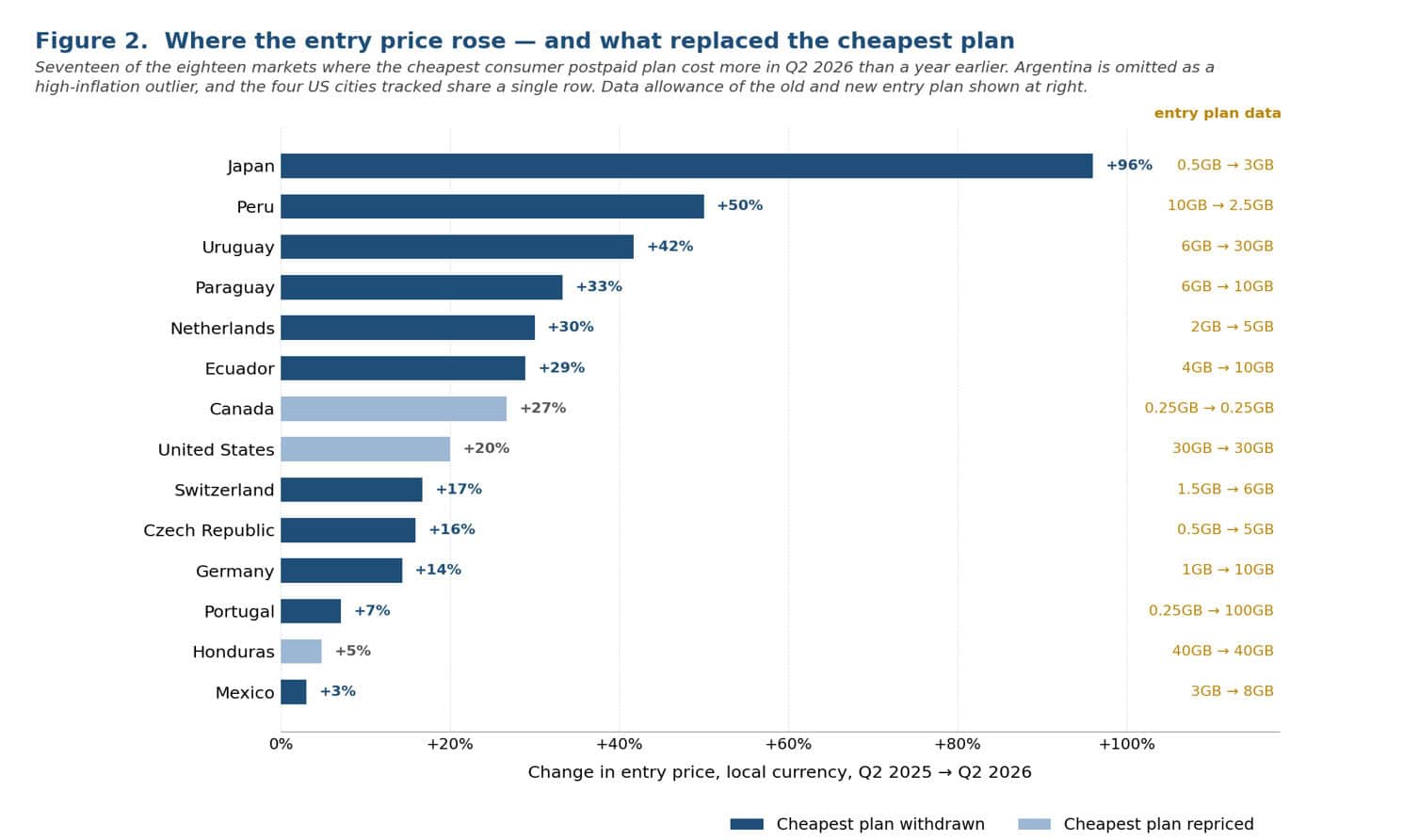
That leaves eighteen markets where the entry price rose, and those are the subject of this study.
All figures here are measured in local currency. The same comparison in euros or dollars would give a materially different and less accurate picture, because exchange-rate movement over the period is large enough to manufacture apparent price changes in markets where operators changed nothing at all.
Where The Floor Rose, The Product Usually Changed
In six of the eighteen markets, an operator raised the price of a tariff it continued to sell. Fido in Canada moved its 250MB Basic BYOP plan from CAD 15 to CAD 19, and Boost Mobile lifted its Unlimited plan from USD 25 to USD 30 across all four American cities tracked. Honduras saw a smaller increase of the same kind. Argentina’s 27 percent nominal rise sits in an economy where inflation makes such comparisons unreliable and is better set aside.
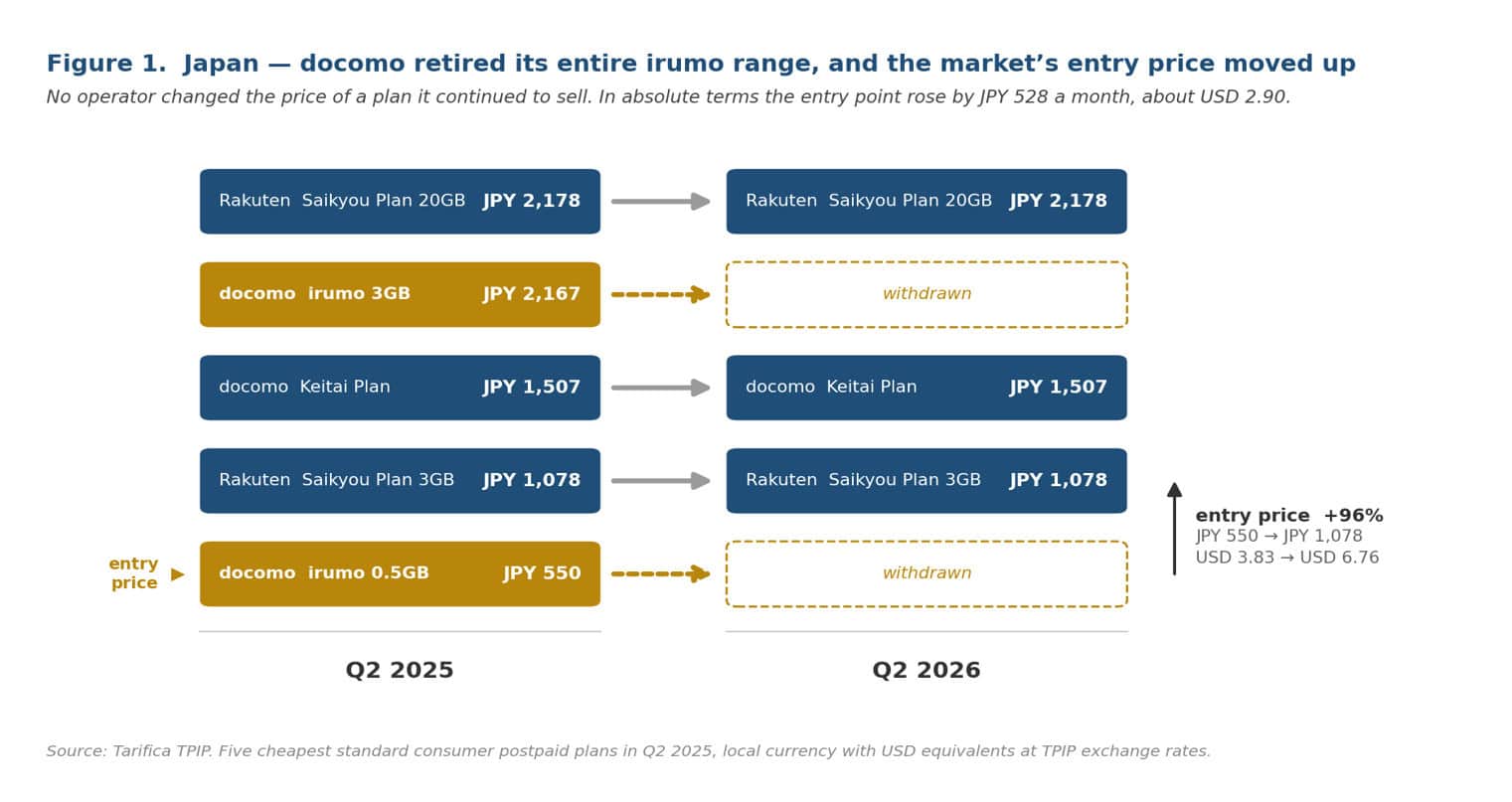
In the remaining eleven markets, the increase happened because the cheapest plan was withdrawn. Japan is the clearest case. Between Q2 and Q3 2025 docomo retired its entire irumo range — four tariffs from 0.5GB to 9GB — taking its own cheapest postpaid plan from JPY 550 to JPY 1,507 and leaving Rakuten’s 3GB tariff at JPY 1,078 as the cheapest postpaid plan in the Japanese market. The entry price rose 96 percent without a single operator changing the price of a plan it continued to sell.
The same pattern appears elsewhere. O2’s NEO+ Start in the Czech Republic offered half a gigabyte for CZK 289 and has given way to a T-Mobile 5GB plan at CZK 335. Swisscom’s basic Mobile XS, 1.5GB for CHF 29.90, has been replaced at the bottom of the Swiss market by Sunrise’s Swiss Connect Lite at CHF 34.90 for 6GB. MEO in Portugal has moved from 250MB at EUR 13.99 to 100GB at EUR 14.99. Simpel in the Netherlands, Personal in Paraguay, CNT in Ecuador, Claro in Uruguay and Movistar in Mexico all show the same shape.
The consistency is what stands out. Of the eighteen markets where the entry price rose, the new cheapest plan carries more data than the old one in ten cases and the same amount in seven. Peru is the single exception: Bitel’s Mi Plan 10GB at PEN 10 has been replaced at the bottom of the market by a 2.5GB tariff at PEN 15, leaving Peruvian consumers with both a higher entry price and a smaller data allowance.
Better Value, Less Choice
Read one way, this is good news. Consumers in these markets are getting substantially more for marginally more money. Germany and the Czech Republic both replaced their cheapest tariff with one carrying roughly ten times the data for around fifteen percent more. Portugal’s floor rose by a euro and the data attached to it rose several hundredfold. Removing tariffs that offered poor value per gigabyte is defensible commercial practice, and in most of these markets the replacement is a better product.
Read another way, the postpaid market has narrowed at its lower end. The German consumer who wanted 1GB did not receive a discount; they acquired an obligation to buy nine gigabytes they had not asked for. That consumer is disproportionately likely to be a light user, a second-SIM holder, a parent buying a child’s first handset, or someone whose data use sits almost entirely on home or workplace Wi-Fi. For that segment the relevant figure is not value per gigabyte but the smallest monthly commitment a postpaid portfolio will accept — and in eighteen markets that figure has gone up.
The amounts involved are small. Across the markets where the entry price rose, the median increase was USD 2.92 a month and none exceeded USD 6.50; Japan’s 96 percent is a move from USD 3.83 to USD 6.76. But the absolute figures are small precisely because the segment is defined by spending little, which is also why the relative change matters: for a consumer buying at the entry point, a near-doubling of the minimum is a near-doubling of the bill. Whether three dollars a month is material depends entirely on who is paying it.
This is specifically a postpaid story. In most of these markets, prepaid packages remain available below the postpaid entry price, and prepaid prices have not moved in the same direction. What has narrowed is the lower end of postpaid portfolios, not necessarily the cost of getting connected.
A Structural Change Worth Watching
The distinction between the two mechanisms matters because they behave differently over time. A price increase can be reversed, and competitive pressure often reverses it. A withdrawn tariff is a portfolio decision, and portfolios tend to move in one direction: operators that have consolidated a long tail of small plans into a single larger entry tier rarely rebuild the tail.
That makes the low end of the postpaid range worth tracking as a category in its own right, separately from the averages that describe the market as a whole. For a regulator assessing whether postpaid markets continue to serve low-usage consumers, the question is not only what the typical plan costs but whether a genuinely small postpaid plan remains available. Prepaid may continue to offer a lower-cost route to connectivity, but across the markets examined, the lower end of postpaid portfolios has clearly narrowed.

About the Author:
Soichi Nakajima
VP Data and Analysis
snakajima@tarifica.com
With over 20 years of telecommunication market analysis experience, Soichi oversees the data collection, quality, research, analysis, and production of all data projects and quantitative studies.
For questions or comments about this analysis, please contact Penny Wiesman at pwiesman@tarifica.com