


The Upload Divide: Why A Gigabit Doesn’t Mean The Same Thing Everywhere.
by Soichi Nakajima
A fiber customer in Madrid buying a gigabit plan gets 1,000 Mbps down and 1,000 Mbps up. A customer in London can pay almost exactly the same monthly price for a gigabit fiber plan and get around 100 Mbps up. Similar headline download speed. Almost the same monthly bill. Around ten times the upload speed.
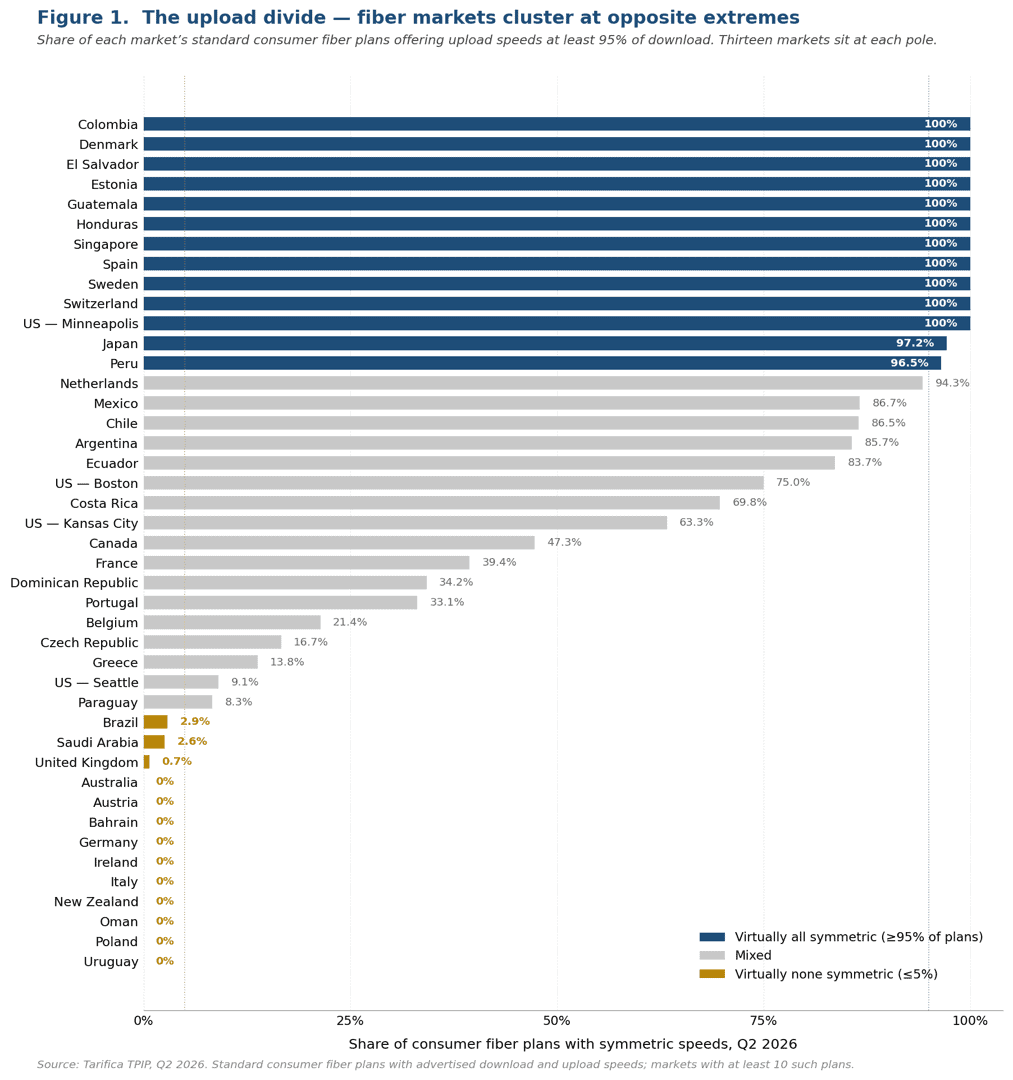
This is not an isolated difference between two operators. Across 43 markets with at least ten tracked fiber plans in Tarifica’s Telecom Pricing Intelligence Platform (TPIP), entire markets have settled on very different versions of what a fiber connection should deliver. Thirteen markets provide symmetric speeds — where upload essentially matches download — on virtually every fiber plan. At the opposite extreme, thirteen provide virtually none. Seventeen sit somewhere in between.
In other words, 26 of the 43 markets sit at one of the two extremes. Whether a consumer buying fiber receives full-speed uploads often has less to do with the price or download speed they choose than with where they happen to live.
Two Very Different Versions of Fiber
The symmetric group includes markets as varied as Spain, Sweden, Switzerland, Denmark, Estonia, Singapore, Japan, Peru, Colombia, El Salvador, Guatemala and Honduras. Every one of Spain’s 87 tracked fiber plans matches upload to download; so do all 308 in Switzerland and all 64 in Sweden. At the opposite pole are markets including the United Kingdom, Germany, Italy, Ireland, Austria, Poland, Australia, New Zealand, Brazil, Saudi Arabia, Bahrain, Oman and Uruguay, where symmetric consumer fiber is virtually nonexistent.
Of the United Kingdom’s 1,113 tracked fiber plans — the largest fiber portfolio in the dataset — just eight are symmetric. All eight are variants of Sky’s 5 Gbps product; below that tier, no tracked UK fiber plan offers symmetric speeds. None of Germany’s 39 tracked plans are symmetric. The remaining seventeen markets are mixed. In countries including the Netherlands and Belgium, symmetric and asymmetric services coexist, sometimes within the same operator portfolios.
What stands out is not the absence of a middle, but the strength of the two extremes. Rather than every market containing a broad mixture of approaches, more than half have settled overwhelmingly on one or the other: fiber is either almost always symmetric or almost never symmetric.
Symmetry Does Not Appear to Command a Premium
There is an obvious explanation for the divide: perhaps symmetric fiber is simply a premium product. However, the pricing data suggests otherwise.
Among gigabit-class fiber plans offering between 800 and 1,500 Mbps download, the median monthly price across the highly symmetric markets is EUR 55.70. Across the highly asymmetric markets, it is EUR 63.44. That does not mean symmetry makes broadband cheaper. Prices differ between countries for many reasons. But it does show that full-speed uploads are not confined to unusually expensive fiber markets.
The contrast becomes clearer when looking at individual European markets. A median gigabit-class fiber plan in Spain costs EUR 56.90 and provides a median 1,000 Mbps upload. In the United Kingdom, the comparable median price is EUR 58.84, but the median upload speed is just 104 Mbps.
Germany’s gigabit-class fiber is more expensive still, at a median EUR 74.98, with a median upload speed of 500 Mbps. Italy goes the other way on price, at EUR 34.99, but has a median upload speed of 300 Mbps.
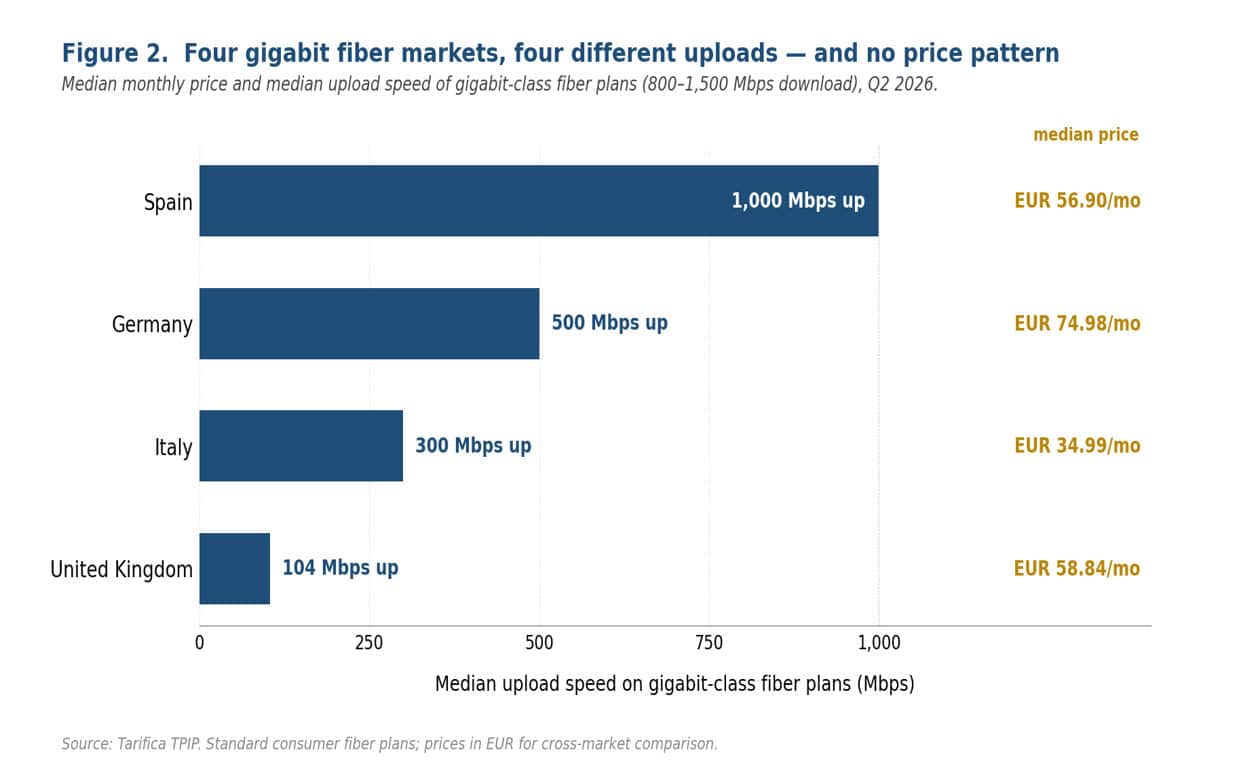
Four large European fiber markets, four very different products behind a broadly similar gigabit download headline. More importantly, symmetry does not consistently command a premium even within markets where both types of service are available. Across 27 country-and-speed-band comparisons, the median price difference between symmetric and asymmetric plans was less than three percent. In some cases symmetric service costs more, in others less, and in many the difference is negligible.
Where symmetry is common, in other words, it generally appears to be part of the fiber proposition rather than an expensive add-on.
The Divide Crosses Very Different Markets
There is no obvious economic dividing line between the two groups. The symmetric side includes wealthy markets such as Switzerland, Singapore, Denmark, Sweden and Japan, but also Latin American markets including Colombia, Peru and El Salvador. The asymmetric side includes Germany, the United Kingdom, Australia and New Zealand. Even neighbouring European markets have developed very different propositions. Spain and Germany are both large broadband markets with extensive fiber deployment, yet a Spanish consumer buying fiber will almost invariably receive matching upload and download speeds while a German consumer almost invariably will not.
Fiber does not automatically mean that retail upload and download speeds must be identical, and there are legitimate technical and network reasons why operators may provision services differently. But the experience of markets such as Spain, Switzerland and Sweden demonstrates that symmetric consumer fiber can be provided at scale and at mainstream price points. The divide therefore cannot be explained simply by symmetric fiber being a capability available only in particular types of market.
The Half of the Connection We Rarely Talk About
Download speed has dominated consumer broadband marketing for decades. A 500 Mbps or 1 Gbps connection is usually described by the number coming into the home. Upload receives far less attention, despite becoming increasingly relevant to how broadband is used. Cloud backups, sharing large files, video calls, livestreaming and content creation all depend on data moving out of the home as well as into it. Two households can therefore buy fiber services carrying the same advertised “1 Gbps” headline while receiving dramatically different performance in the other direction.
For consumers, that raises a question about what the headline broadband speed actually describes. For operators, particularly in asymmetric and mixed markets, it raises another: if comparable fiber markets already provide symmetry at mainstream prices, how long will upload speed remain largely invisible in the consumer proposition?
Tarifica’s data does not show that consumers are willing to pay extra for symmetry. Across the markets studied, there is little evidence of a consistent price premium at all. That may be the most interesting part of the divide.
In one group of markets, full-speed upload has effectively become part of the standard fiber product. In another, upload remains a separate dimension on which service is restricted or differentiated. Both are selling fiber. Both increasingly advertise the same gigabit download speeds. But depending on where consumers live, what sits behind that headline number can still be a very different broadband product.
About the Analysis
The analysis uses standard consumer fiber plans tracked in Tarifica’s Telecom Pricing Intelligence Platform in Q2 2026. A plan is classified as symmetric when its advertised upload speed is at least 95% of its advertised download speed. A market is classified as virtually all symmetric when at least 95% of its tracked fiber plans meet that definition, and virtually none when 5% or fewer do. Markets must have at least ten tracked consumer fiber plans to be classified; 43 of the 46 markets covered met that threshold.
In the United States, TPIP tracks individual metropolitan markets rather than treating the country as a single national market; these therefore appear separately in the analysis.

About the Author:
Soichi Nakajima
VP Data and Analysis
snakajima@tarifica.com
With over 20 years of telecommunication market analysis experience, Soichi oversees the data collection, quality, research, analysis, and production of all data projects and quantitative studies.
For questions or comments about this analysis, please contact Penny Wiesman at pwiesman@tarifica.com